The Comparison Trap: Why Benchmarking Your Processing Fees Against Industry Averages Is Costing You More Than You Think
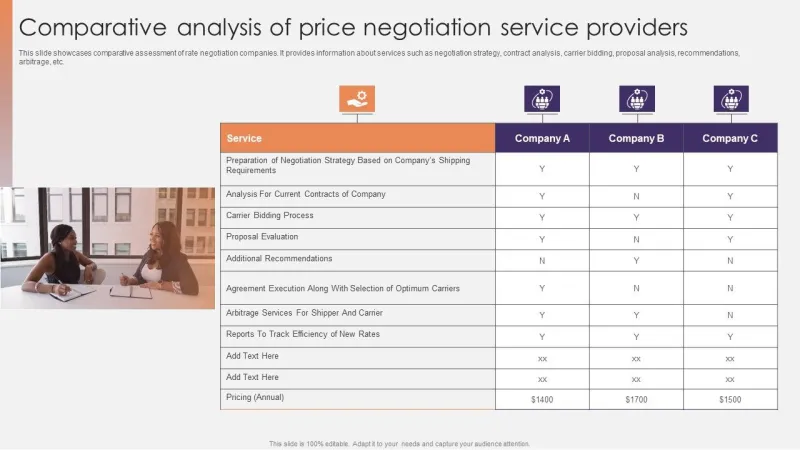
Photo: business fee comparison contract negotiation finance analysis, via www.slidegeeks.com
When US merchants sit across the table — or on a call — from a payment processor's sales team, one of the most common negotiating moves is the competitive rate reference. "We're currently paying X percent. What can you do?" It feels like leverage. In practice, it frequently is not, because the number being referenced rarely reflects what the merchant is actually paying, and the number being offered rarely reflects what they will actually pay.
Processor fee structures are not uniformly designed for clarity. They are, in many cases, designed for the opposite. Understanding why industry-average benchmarks fail as a negotiating tool — and what to use instead — is one of the more consequential financial disciplines available to US merchants.
Why 'Industry Standard' Is a Moving Target With No Fixed Address
The concept of an industry-standard processing rate presupposes a degree of fee structure uniformity that does not exist in the US payment processing market. Different processors use fundamentally different pricing architectures, and comparing a rate from one architecture against a rate from another is less like comparing prices at two grocery stores and more like comparing the price of a single ingredient against the price of a prepared meal.
The three dominant pricing models in use among US processors — interchange-plus, tiered pricing, and flat-rate pricing — produce dramatically different cost profiles for the same underlying transaction volume. A merchant paying 2.6 percent flat rate is paying a fundamentally different thing than a merchant paying interchange-plus 0.3 percent plus $0.10 per transaction, even if the effective rate on a given month appears similar. The flat-rate merchant is subsidizing the processor's cost on premium rewards cards. The interchange-plus merchant's costs fluctuate with card mix. Neither rate is more or less "standard" — they are simply different products.
When a merchant benchmarks against an industry average rate, they are typically referencing a number derived from a mix of these incompatible structures. That average is arithmetically coherent but operationally meaningless as a negotiating reference.
The Fragmentation Problem: How Fee Schedules Obscure Total Cost
Even within a single pricing architecture, processor fee schedules are structured in ways that make total cost calculation non-trivial. The advertised or negotiated rate — the headline percentage — is typically the largest but not the only cost component. Merchants who focus negotiations exclusively on this number are leaving significant cost surface unexamined.
Additional fee categories that materially affect total processing cost include:
Monthly and annual account fees. Platform fees, statement fees, PCI compliance fees, and gateway fees are billed separately from transaction rates and can add hundreds to thousands of dollars annually to the total cost of processing.
Per-transaction fees. Fixed per-transaction charges (commonly expressed as cents per transaction) have an outsized cost impact for merchants with low average ticket sizes. A $0.10 per-transaction fee on a $5.00 average ticket represents a 2 percent additional cost layer before the percentage rate is applied.
Downgrade fees and non-qualified surcharges. Under tiered pricing structures, transactions that fail to qualify for the lowest rate tier — due to card type, entry method, or data submission completeness — are assessed additional fees. These downgrades can affect a substantial portion of transaction volume without being visible in headline rate comparisons.
Chargeback and retrieval fees. Dispute-related fees are assessed per incident and can accumulate significantly in volume-sensitive businesses. These fees are rarely included in rate comparisons but belong in any honest total-cost calculation.
Early termination fees and contract escalation provisions. The cost of a processor relationship is not limited to its current fee schedule. Contracts that include annual rate escalation clauses or significant early termination penalties carry a future cost obligation that belongs in the present-value calculation of any fee negotiation.
How Pursuing the Average Locks You Into a Worse Deal
The anchor effect in negotiation is well-documented: the first number introduced in a negotiation exerts disproportionate influence on the final outcome. When a merchant opens negotiations with an industry-average rate benchmark, they have anchored the conversation to a number that the processor's sales team is prepared to engage with — because they know exactly what that number is and how to construct a competing offer that appears to beat it while preserving or expanding margin elsewhere.
A processor that agrees to match or slightly undercut a merchant's stated benchmark rate can simultaneously introduce or increase fees in other categories — monthly minimums, gateway charges, chargeback fees — that more than recover the margin conceded on the headline rate. The merchant leaves the negotiation believing they won. The processor's total revenue from the account has not decreased.
This is not hypothetical. It is the operational logic behind the practice of offering promotional rates to new merchants while maintaining fee schedules in supplemental documents that are technically disclosed but rarely reviewed in detail before signing.
A More Reliable Framework for Evaluating Processing Costs
Effective fee evaluation requires moving from rate comparison to effective rate calculation — a number that accounts for all fee categories relative to total processing volume.
Calculate your current effective rate. Divide your total monthly processing costs — including all fees, not just transaction-percentage charges — by your total monthly processing volume. This produces a single percentage that reflects what you are actually paying. For most US merchants, this number is meaningfully higher than their headline rate.
Request fully itemized fee schedules from competing processors. When soliciting proposals, require a complete fee schedule in writing — not a summary rate card. Ask specifically about monthly fees, per-transaction fees, chargeback fees, and any fee categories that can change without requiring contract amendment.
Model cost against your actual transaction mix. Apply proposed fee schedules to your actual historical transaction data — including card type distribution, average ticket size, and refund rate — rather than against a simplified average. The same fee schedule can produce materially different effective rates for different transaction mixes.
Evaluate total contract cost, not current rate. Include the impact of any rate escalation provisions, early termination fees, and minimum monthly charges in your cost comparison. A rate that appears favorable today may be contractually obligated to increase over the agreement term.
Payment processing fees are not a commodity category where price comparison yields straightforward answers. They are a multi-variable cost structure that requires deliberate analysis to evaluate honestly. Merchants who invest in that analysis — rather than relying on industry benchmarks as a proxy — consistently identify meaningful savings that surface comparisons cannot reveal.