The Quiet Revenue Leak Draining Subscription Businesses: Why Failed Renewals Deserve More Attention Than Chargebacks
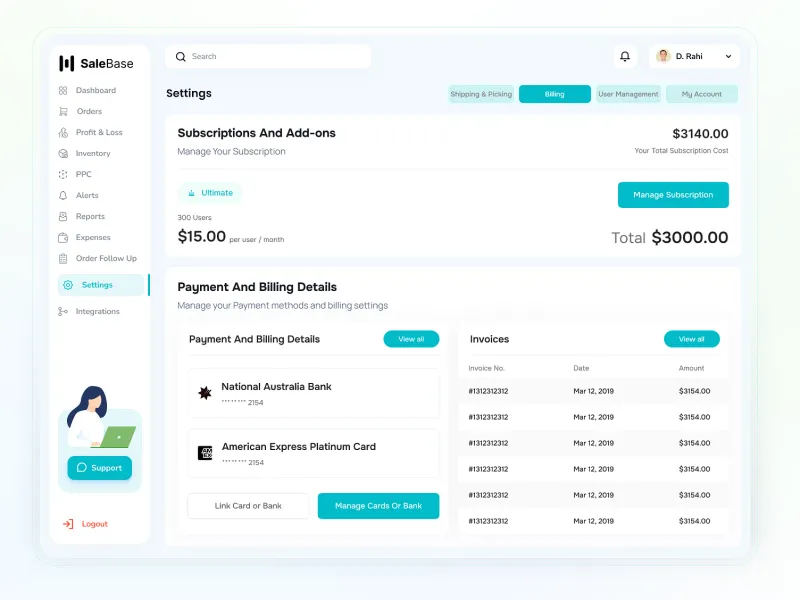
Photo: subscription billing dashboard recurring payments business, via cdn.dribbble.com
Subscription businesses spend considerable energy defending against chargebacks. Dispute management tools, fraud screening, compelling evidence documentation — these are well-understood practices with a growing ecosystem of solutions built around them. Yet for many recurring billing operations, a far larger revenue leak goes almost entirely unaddressed.
Failed subscription payments — transactions that decline silently at renewal, leaving no dispute, no notification, and often no immediate awareness — represent one of the most underestimated sources of revenue loss in the subscription economy. Industry estimates suggest that involuntary churn, the term for subscriber loss caused by payment failure rather than customer intent, accounts for somewhere between 20 and 40 percent of total subscriber attrition for the average subscription business.
That is not a rounding error. That is a structural problem hiding inside the billing cycle.
Why Recurring Payments Fail More Often Than You'd Expect
Card-based recurring billing operates under a fundamental tension: the payment method stored at signup becomes less reliable over time. Cards expire. Banks reissue cards after security incidents — and in the US, where large-scale data breaches remain common, mass reissuances happen with regularity. Customers change banks, update card numbers, or hit credit limits without any direct communication to the subscription business.
The result is a predictable degradation in payment method reliability the longer a customer remains subscribed. A card that processed cleanly at signup may fail at the 12-month renewal for reasons entirely unrelated to the customer's desire to continue the service.
Beyond expiration, soft declines create a more nuanced problem. Unlike hard declines — outright rejections due to fraud flags or closed accounts — soft declines are temporary. Insufficient funds, a bank's automated fraud trigger, or a daily transaction limit can cause a renewal to fail at a specific moment even when the card is otherwise valid and the customer has every intention of continuing. Standard payment processors often treat soft declines with the same finality as hard ones, making a single attempt and moving on.
For the subscriber, the experience is abrupt and often confusing. For the business, it's invisible revenue loss.
The Customer Retention Cost Nobody Calculates
When a subscription renewal fails and the account lapses, the business faces a recovery problem that compounds quickly. Reacquisition is expensive. The cost of winning back a lapsed customer — through email sequences, promotional offers, or paid retargeting — routinely exceeds the cost of a single missed renewal. And that calculation doesn't account for the customers who simply never return.
Consider the lifetime value math. A subscriber paying $49 per month with an average tenure of 24 months represents $1,176 in lifetime revenue. If a payment failure at month 14 causes that subscriber to lapse and not return, the business doesn't lose $49 — it loses the remaining $490 in projected revenue, plus whatever reacquisition cost is incurred trying to win them back.
Multiply that across hundreds or thousands of monthly renewal attempts, and the aggregate impact on annual recurring revenue becomes significant. A subscription business with 5,000 active subscribers, a 3% monthly failure rate, and a 40% recovery rate on failed renewals is losing meaningful revenue every single month — not to fraud, not to intentional cancellation, but to payment infrastructure limitations.
Where Standard Processors Fall Short
Most general-purpose payment processors were designed primarily around one-time transactions. Recurring billing was added as a feature, not built as a core competency. The result is that retry logic — the mechanism that determines whether and when to reattempt a failed transaction — is often rudimentary.
A single retry at a fixed interval, or no retry at all, is common. This approach ignores what payment data actually shows: that the optimal retry window varies by decline reason, day of week, time of day, and card network. A transaction that fails on a Monday morning due to a temporary hold may succeed on Wednesday afternoon. A processor without intelligent retry logic will never attempt to find out.
Additionally, many standard processors do not distinguish meaningfully between decline types when triggering customer communication. A customer whose card has genuinely expired receives the same generic "payment failed" notification as one who was declined due to a momentary bank error. The former needs to update their payment method. The latter may simply need to wait for a retry. Sending the wrong message — or no message at all — at the wrong moment creates friction that accelerates cancellation.
What Modern Recovery Looks Like
Payment platforms built with subscription businesses in mind approach renewal failure as a recoverable event, not a terminal one. Intelligent retry logic uses decline code data and machine learning to determine the most likely successful retry window for each specific failure type. Rather than making one attempt and issuing a failed payment notice, these systems work through a structured recovery sequence that maximizes the probability of success before escalating to customer communication.
Dunning management — the process of communicating with customers about payment issues — has also evolved considerably. Effective dunning sequences are personalized, timed strategically relative to the renewal date, and calibrated to the specific failure reason. A subscriber whose card expired gets a direct, low-friction link to update their payment method. A subscriber whose decline appears to be a temporary bank issue may receive a softer message that buys time for automated retries to succeed.
Account updater services add another layer of defense. These tools, available through major card networks, automatically push updated card numbers and expiration dates to merchants when a bank reissues a card. For subscription businesses, this means a significant portion of expiration-related failures never reach the billing attempt at all.
Businesses that implement this full stack of recovery tools — intelligent retries, account updater integration, and tiered dunning communication — consistently report material improvements in renewal success rates. Recovery rates of 60 to 80 percent on initially failed renewals are achievable when the infrastructure is designed for it.
Treating Renewal Failure as a Solvable Problem
The mindset shift required here is straightforward but consequential. Failed subscription payments are not an inevitable byproduct of recurring billing. They are a technical and operational problem with known solutions — solutions that are available to businesses willing to evaluate their payment infrastructure critically.
If your current processor cannot answer specific questions about retry logic, decline code handling, account updater enrollment, and dunning automation, that absence of capability is costing you revenue every billing cycle.
At TCPayFast, we treat recurring payment reliability as a core function, not an afterthought. Because in subscription commerce, the payment that processes quietly in the background is just as important as the one that converts a new customer at checkout.